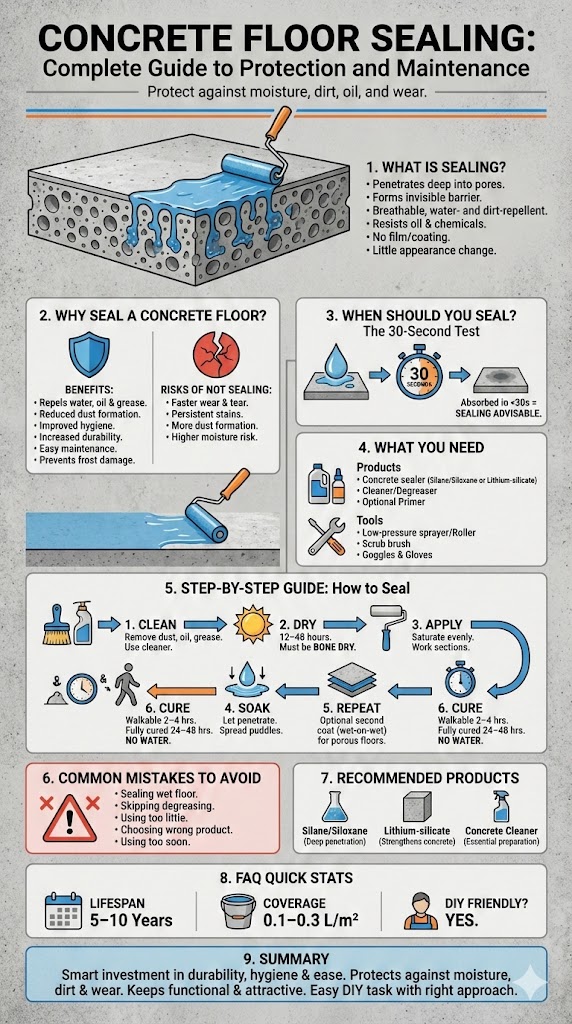
 Concrete Floor Sealing: Complete Guide to Protection and Maintenance
Sealing a concrete floor is one of the most effective ways to protect it against moisture, dirt, oil, stains and wear. Whether it’s a garage floor, workshop, terrace, driveway or industrial space, a proper sealing treatment extends the lifespan of the concrete and makes maintenance significantly easier. This comprehensive guide explains what sealing is, when it’s needed, which products to use and how to apply them step by step.
1. What Is Concrete Floor Sealing?
Concrete floor sealing involves applying a liquid sealer that penetrates deep into the pores of the concrete. It forms an invisible, water‑ and dirt‑repellent barrier that protects the surface without creating a film or coating.
A sealed concrete floor:
-
remains breathable
-
becomes water‑repellent
-
resists oil, grease and chemicals
-
wears down more slowly
-
is easier to clean
The appearance of the floor changes little or not at all.
2. Why Seal a Concrete Floor?
A sealing treatment offers several important benefits:
Benefits
-
Protection against moisture and stains Water, oil and grease are less likely to penetrate the concrete.
-
Reduced dust formation Unsealed concrete can release dust over time.
-
Improved hygiene Ideal for garages, workshops, kitchens and industrial floors.
-
Increased durability The floor lasts longer and stays in better condition.
-
Easy maintenance Dirt adheres less and is easier to remove.
-
Prevents frost damage outdoors Less moisture in the concrete means fewer cracks.
Risks of NOT sealing
-
Faster wear and tear
-
Persistent stains
-
More dust formation
-
Higher risk of moisture problems
3. When Should You Seal a Concrete Floor?
Sealing is recommended when:
-
the concrete floor is porous
-
stains appear from oil, grease or moisture
-
the floor is heavily used (garage, workshop, warehouse)
-
the floor is outdoors and exposed to rain and frost
-
you want to protect a new concrete floor from the start
A simple test: Pour a small amount of water on the floor. If it absorbs within 30 seconds, sealing is advisable.
4. What You Need
Products
-
Concrete sealer (silane/siloxane or lithium‑silicate)
-
Optional: concrete cleaner or degreaser
-
Optional: primer for highly porous concrete
Tools
-
Low‑pressure sprayer or roller
-
Scrub brush or floor cleaner
-
Protective plastic and tape
-
Safety goggles and gloves
5. Step‑by‑Step Guide: How to Seal a Concrete Floor
Step 1: Clean the floor thoroughly
Remove dust, dirt, oil and grease. Use a degreaser or concrete cleaner if necessary.
Step 2: Allow the floor to dry completely
Concrete must be dry for optimal absorption. Drying time: 12–48 hours, depending on temperature and ventilation.
Step 3: Apply the sealer
Use a low‑pressure sprayer or roller. Work evenly and ensure the floor becomes fully saturated.
Step 4: Let the product soak in
The sealer should penetrate the concrete without forming puddles. Spread excess product with a roller.
Step 5: Apply a second coat if needed
Highly porous concrete may require a second wet‑on‑wet coat.
Step 6: Allow the floor to cure
The floor is walkable after 2–4 hours, but fully cured after 24–48 hours. Avoid water and heavy loads during this period.
6. Common Mistakes to Avoid
-
Sealing a wet floor Prevents proper absorption.
-
Using too little product The floor must be saturated.
-
Skipping degreasing Oil and grease block penetration.
-
Choosing the wrong product Not all sealers are suitable for concrete.
-
Using the floor too soon after treatment Can cause streaks and marks.
7. Recommended Products
-
Silane/Siloxane concrete sealer – deep penetration, water‑repellent
-
Lithium‑silicate sealer – strengthens the concrete, ideal for industrial use
-
Concrete cleaner/degreaser – essential for proper preparation
8. Frequently Asked Questions
How long does a concrete sealer last? Typically 5–10 years, depending on usage and product quality.
How much sealer do I need? Between 0.1 and 0.3 liters per m², depending on porosity.
Can I seal a concrete floor myself? Yes — with proper preparation and tools.
Is sealing the same as coating? No. Sealing penetrates the concrete, while coating forms a layer on top.
9. Summary
Sealing a concrete floor is a smart investment in durability, hygiene and ease of maintenance. By protecting the floor against moisture, dirt and wear, it stays functional and attractive for many years. With the right products and a careful step‑by‑step approach, it’s a task you can easily perform yourself.
No comments found.